
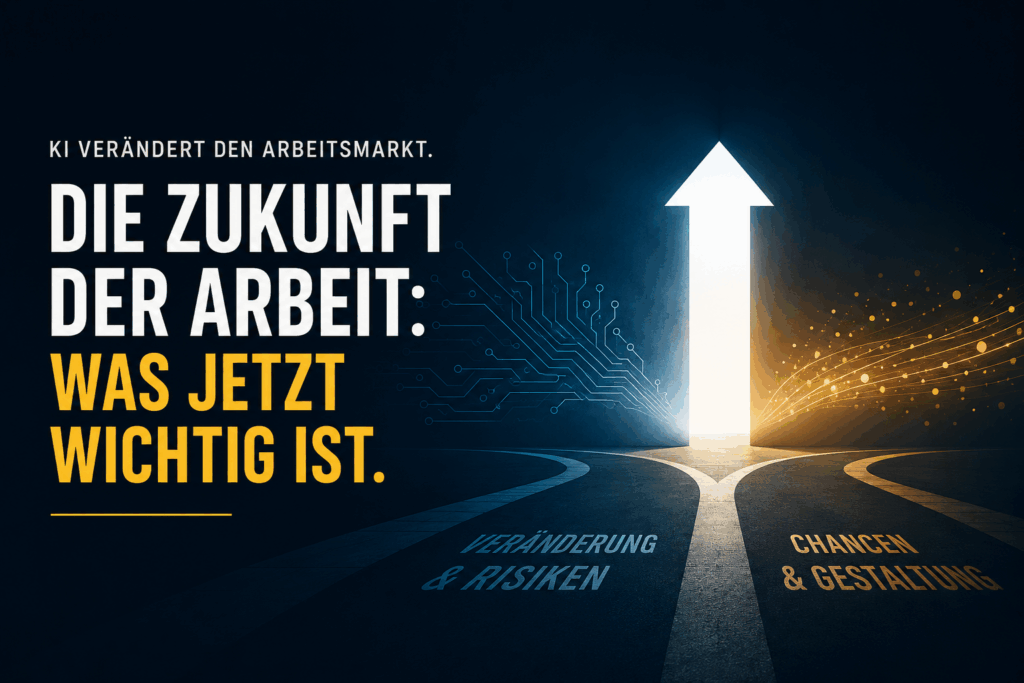
An honest conversation that many would rather avoid – but that you should have now.
In April 2026, Sam Altman (OpenAI) and Dario Amodei (Anthropic) issued almost identical warnings: AI is developing faster than society and politics are prepared for it. No hype, no sales pitch – but a sober assessment from the people building the technology themselves.
The Everlast AI podcast subsequently brought together three experts: Prof. Dr. Pero Mićić (future strategist), Prof. Dr. Andreas Moring (AI & digital economy), and Kim Isenberg (AI entrepreneur and newsletter author). The result is one of the clearest, most factual conversations on the topic of post-labour economics that we have seen to date.
👉 Click here to go straight to the video
For those who prefer to read, here are the main points.
It's no longer a future scenario. It's happening now:
And that’s just the beginning. The experts agree: we are currently seeing only a fraction of the impact that is set to unfold over the next 10 to 15 years.
"When cognitive jobs disappear, everyone will become a plumber." This argument has been circulating for years – and sounds reassuring. Unfortunately, it's not entirely true.
Two hooks that name the conversation very clearly:
Firstly: Even in a small business, around 70% of the roles are white-collar jobs: administration, preparing quotes, and customer communication. All of these can be replaced by AI.
Secondly If millions of office workers flock to the trades, wages there will collapse. It's simply supply and demand.
And in 10 to 15 years, the dexterity of robots will reach that of humans – then skilled trades will also come under pressure.
The image that is making the rounds is that of a barbell (Barbell Economy):
Middle management, classic knowledge work, coordinating roles – precisely what Germany's strong middle class is built on, is under massive pressure.
Sam Altman has lamented that Washington is not prepared. Prof. Moring puts it succinctly: "We don't even want to ask if Berlin is prepared for it."
Germany has been in economic stagnation for years, has slept through digitalisation and struggles with bureaucracy that actively prevents AI experiments in companies. While US companies deploy new coding agents daily, in this country, critical information in many medium-sized businesses is still stored exclusively in employees' heads – and not digitised.
But Mićić describes three scenarios: horror, crisis, and abundance. The latter is the likely long-term outcome – if the productivity gains from AI are widely distributed. Work performance will become so cheap that products and services will deflate. Just as we live in abundance today compared to kings 300 years ago, we will live in abundance in 20–30 years compared to today.
We will hardly avoid the crisis scenario – it is the transition. But the horror scenario is not inevitable. It depends on what businesses, society and politics do now.
The three experts formulate clear recommendations for action – no reassurances.
1. Actively use AI, don't just observe it. Anyone who isn't already working with AI tools daily is wasting time they don't have.
2. Not wanting to become a cyborg. AI has already surpassed us in many areas. The race to beat the machine is the wrong strategy. The right one is to deploy what AI cannot do: empathy, judgment, experiential knowledge, genuine human relationships.
3. Building productive capital. Anyone who is solely dependent on wage labour is vulnerable in the long term. Ownership of productive capital – company shares, stocks – is what makes pensioners independent. This logic increasingly applies to everyone.
4. Rethinking the company. Not: How do I replace people with AI? But rather: If we were to start over today – how would we build it? Anyone who doesn't ask this, is having a dozen teams somewhere in the world do it for them right now.
For years, ITCS has been the place where IT talent meets companies looking to shape the future. This very context is now fundamentally changing.
For Visitors The question is no longer just "which job is right for me?" – but rather "which skills will still be in demand in 5 years, and how do I position myself now?"
For Exhibitor Those who merely fill vacancies will lose out. Those who demonstrate how their company works with AI and how employees benefit from it will attract the talent that truly makes an impact in this world.
The conversation in the video is long – over 2.5 hours. But it is one of the few that doesn't break off the debate halfway through.
What questions are you pondering regarding AI and the job market? Write to us – or discuss them directly at the next ITCS.
At ITCS, it's all about tech, careers, and the future of the digital world — from AI and software development to cybersecurity, cloud, and data.
🎥 In our Media library You'll find lectures on current tech topics from our events.
🎙️ I'm Pizzatime Tech Podcast Let's talk to experts, companies and the community about trends, technologies and careers.
💼 In our Job listings awaiting current tech jobs from companies actively shaping the digital future.
Additionally, you can watch the ITCS live on our Upcoming events experience or over the Newsletter Receive new talks, jobs, and tech insights.
You are currently viewing placeholder content from VimeoTo access the actual content, click the button below. Please note that doing so will share data with third-party providers.
Further informationYou are currently viewing placeholder content from YouTubeTo access the actual content, click the button below. Please note that doing so will share data with third-party providers.
Further informationYou need to load content from reCAPTCHA to submit the form. Please note that doing so will share data with third-party providers.
Further informationYou need to load content from hCaptcha to submit the form. Please note that doing so will share data with third-party providers.
Further information English
  German